-
Are you a good bug or a bad bug?
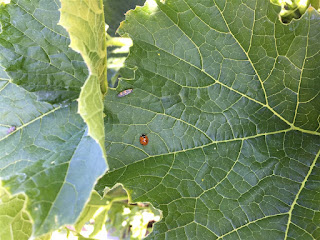
The photo contains a ladybug and larva – one in the same species. Every agricultural college will have accurate and reliable information useful to all readers and also designed for that geographic area and plant zones. Bugs are seasonal and some are plant species specific, while others are more omnivorous like some species of crickets from the Order Orthoptera, Suborder Ensifera, Family Fryllidae, Genus Acheta and Species (900 world wide, 100 in the US) Their diet is primarily composed of a mixture of plant and smaller insects. Many species such as the earwig (Order Dermaptera are also omnivorous. [Photo credit Judy Thierry, July 2017]
Check out this site with great photos from Oregon State http://oregonstate.edu/dept/nurspest/Insects see if you can find their photo of the hollyhock weevil.
-
Harvesting – are you diligent?
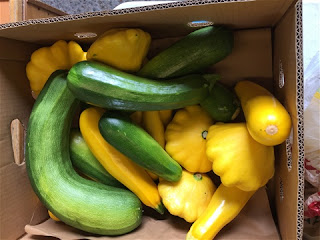
Ok so you have planned, made your soil ready, got your starts or planted your seeds directly and watered and now there is a lush green canopy. What is underneath, in the ground, vining upward that is demanding your attention? Why harvest? Isn’t that what you wanted to do, to have fresh produce?
Requirements
1. Frequent – make a 2 to 3 times a week visit to the garden OR ask the harvest team to take your donations. Why? Harvesting encourages increased plant yields. Think of your plant as an assembly line; someone, that means YOU needs to be at the end of the line taking the fruits and vegetables off the conveyor belt! Lettuce, all greens that bolt or are even said to not bolt need to be harvested regularily.
2. The giant zuchinni monster while edible signals the plant to actually die back. Yikes! Didn’t you plant it to get lots of produce – not just one big baby! Pick often and smaller and get more yields.
3. Tomatoes ripen and as they ripen they actually soften a bit making the fruit sweeter and signaling other fruit on the vine to ripen. Amazing. Miraculous. Science.
4. Fertilize the soil every three – four weeks. We have fish fertilizer in the shed.
5. July planting of fall and winter vegetables need fertile consistently moist soil. For details consult the chart in the shed, read and consult “Maritime Northwest Garden Guide,” by Seattle Tilth “a planning calendar for year-round organic gardening.” Principle Author, Lisa Taylor, 2nd Edition. ISBN 0-931380-20-0.
6. Use sharp scissors or pointed clippers for easy access to the stems. Weed and trim diseased leaves as you go.
7. Trellis vining vegetables and restake as needed your tomatoes.
8. Mulch (2 – 4″) !!! Provide shade for greens that tolerate indirect sunlight and are happier in soil with a cooler temperature.
-
The ground beneath…
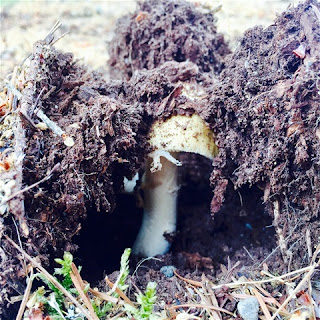
I don’t think I have ever noticed how the mushroom pushes itself up with its cap like an umbrella. The picture at ground level tells the story. A time lapse would be awesome. The earth is dry. No rain in the forecast. A layer of mulch 2-4″ will help keep your vegetables from wilting midday and reduce overall water use. REMEMBER to water the roots Best to water early to mid morning or late afternoon.
-
Lettuce
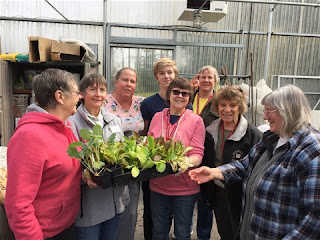
Thanks to Tanya who shared this link with me. http://homeguides.sfgate.com/trim-lettuce-regrow-71305.html Harvesting lettuce for maximum yield. As we have rushed from cold rain and partial sun to dry sunny and 78 degrees the lettuce is adjusting too. When the main stalk begins to elongate it is bolting or entering flowerIng state. We see this with kale, other greens and radishes. Don’t forget to water mulch and fertilIze. Liquid fish fertilizer is in the shed. Photo: Urban Edibles group in the Puyullup MG Demo Garden hoop house with starts given to UPCG 2017.
-
Claytonia perfoliata

Sort of rolls off your tongue if you say it outloud. Clay-toe-nee-ah Per foe-lee-ah-ta…Miners lettuce which you will find in the UPCG garden is an edible green. This excerpt from Baker Creek Heirloom Seeds: “(Claytonia perfoliata) This West Coast native appears abundantly there in the early spring. Succulent, mildtasting leaves are not unlike spinach in texture, and saved many Gold Rush miners from scurvy. Enjoy it in salads or lightly steamed. Also makes a charming ground cover in the spring garden. Also known as Winter Purslane.” http://www.rareseeds.com/miners-lettuce/
-
Strawberries Fragaria × ananassa- Rosaceae or rose family – vocabulary words runner or stolon, crown
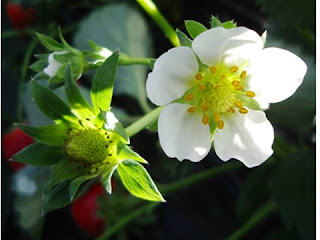
I love the questions from our member gardeners – causing me to see my own knowledge gaps. This on strawberry plants, a new world species. They have two mechanisms for reproduction. Sexual reproduction with fruit and seed, and asexual reproduction by sending out runners or stolons with tiny plants at the end. The crown of a strawberry plant when planted should sit at soil level with the roots spread out and planted deep. Runners can be planted to a pot or removed if you want to maintain the mother plant vigor.
Photo credit: https://commons.wikimedia.org/wiki/File:Strawberry_flower.jpg
This from wikipedia: “The garden strawberry was first bred in Brittany, France, in the 1750s via a cross of Fragaria virginiana from eastern North America and Fragaria chiloensis, which was brought from Chile by Amédée-François Frézier in 1714.[2]Cultivars of Fragaria × ananassa have replaced, in commercial production, the woodland strawberry (Fragaria vesca), which was the first strawberry species cultivated in the early 17th century.[3]
-
Rain, Rain water, Green River Snowmelt and Water From Your UPCG Garden Hose
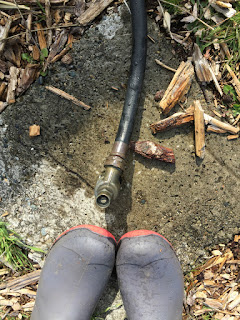
Water everywhere and seemingly everyday, this spring, and yet, come July and August, plants will wilt and die in hours if not properly watered, mulched and rooted in porous soil. How can this be? How do we strike a balance and do we really have to plan for 3 – 4 months ahead. Soil building is a constant effort. Mulch can keep excess water out or slow it down and also hold in water when dry winds and heat cause rapid evaporation. It works both ways. Using compost that we generate as a mulch or amendment into the soil will improve porosity, water holding ability, soil nutrtion with slow release to the plants supporting soil structure. We have two square compost sieves. Grab a handful of compost and compare it with the tagro potting soil. While both are biolgically active – meaning there is bacteria and other soil organisms the compost is uniquely alive. Remember to separate GREENS from BROWNS. Cut up pieces to 6″ if you can. It will make composting easier. Avoid adding blackberry canes they pierce even the gloved hand. Avoid adding crab grass with those long white rhizone type roots. Weeds with obvious seeds are a no no, but everything else is nitrogen or carbon and belongs in our composting operation. YOU CAN ALSO COMPOST IN PLACE adding finely chopped up garden waste back into your bed directly. TRY IT.
Now back to our garden tap water source. The Green River Watershed on the western side of the Cascades south of Snolqualmie is shared with several cities. Tacoma Water website has a great read for this resource for all seasons: https://www.mytpu.org/tacomawater/water-source/green-river-watershed/ and management plan: https://www.mytpu.org/file_viewer.aspx?id=764
-
Onions – seeds, sets or transplants? A new member question
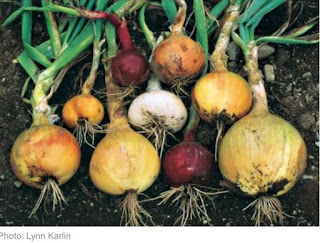
Lots of onion interest in this garden.
You’ll see garlic growing and onion sets have been planted in a few beds.
The sets go faster. Start with the bulb no larger than dime size.
Seed- They produce from seed to full onion in 5 months. April, May, June, July, …end August!
Harvest to table has a nice piece on onions.
http://www.harvesttotable.com/2011/05/onion_growing_tips/
Thanks for asking.
Try to find organic sets. Lots of companies have seeds are that are organic.
-
Gardening Health and Safety Tips – Family Health – CDC

Do you know your tetanus vaccination status? Every 10 years.
“All adults should get a tetanus vaccination every 10 years. Tetanus lives in the soil and enters the body through breaks in the skin. Because gardeners use sharp tools, dig in the dirt, and handle plants with sharp points, they are particularly prone to tetanus infections. Apr 22, 2014.
This from the Centers for Disease Control and Prevention (CDC)

University Place Community Garden
Stewardship & Community Creating Food Security
 University Place Community Garden
